Although our main goal for our most recent trip to Scotland was to learn about authentic Scottish food, we couldn’t help but take part in some other Scottish traditions. These traditions focus on Scottish drinks. Although there is one particular drink that Scotland is famous for, it’s not the only thing to drink. In this Scottish Drinks Guide, we share our recommendations for the must try drinks in Scotland.
Traditional Scottish drinks encompass world-renowned spirits, historic malt-forward ales, botanical gins, and beloved non-alcoholic staples, led by Single Malt Scotch Whisky (uisge beatha) as Scotland’s official national alcoholic drink and Irn-Bru as its national soda. From smoky Islay malts and honeyed Drambuie liqueurs to cask-conditioned 80 Shilling ales and Edinburgh gin, Scotland’s drinking culture reflects centuries of local distilling mastery and pure soft highland water sources.
*This post contains compensated links. Find more info in my DISCLAIMER. As an Amazon Associate, I earn from qualifying purchases.
Quick Facts About Scottish Drinks
| Iconic Scottish Drink | Drink Category & Base Ingredients | Flavor Profile & Key Characteristics | Traditional Serving Style |
| Scotch Whisky (Single Malt) | Spirit; 100% malted barley, water, & yeast | Ranges from rich, sweet, and floral (Speyside) to heavily peated, smoky, and briny (Islay). | Served neat in a tulip-shaped Glencairn glass or with a few drops of water. |
| Irn-Bru | Carbonated soft drink (caffeine & quinine) | Sweet, bright orange soda with distinctive bubblegum, citrus, and slightly metallic notes. | Served ice-cold straight from the can or glass bottle; popular hangover cure. |
| Drambuie | Spiced honey liqueur (Scotch whisky base) | Rich, velvety, and sweet with notes of heather honey, herbs, saffron, and spices. | Served on the rocks or mixed with Scotch whisky as a Rusty Nail cocktail. |
| Scottish Cask Ale (80/-) | Traditional top-fermented ale; malted barley | Malt-heavy, nutty, sweet caramel notes with low hop bitterness and gentle natural carbonation. | Served cellar-temperature from a traditional hand-pull cask tap at the pub. |
| Scottish Botanical Gin | Distilled spirit (neutral grain & wild botanicals) | Crisp juniper balanced with local flora like rowan berries, heather, and bog myrtle. | Served with premium tonic water, garnished with fresh red apple slices or herbs. |
| Whisky Mac | Classic cocktail (equal parts Scotch & green ginger wine) | Warming, spicy, and soothing with potent ginger heat balancing the rich malt whisky. | Served at room temperature or with ice in a short tumbler on cold rainy days. |
| Scottish Breakfast Tea | Robust black tea blend (Assam, Ceylon, African) | Full-bodied, brisk, and astringent; formulated specially to brew cleanly in Scotland’s soft water. | Served hot with fresh whole milk and sugar alongside morning breakfast or scones. |
| Tennent’s Lager | Scottish pale lager (barley, water, hops) | Clean, crisp, lightly biscuity, and refreshing with mild carbonation and a dry finish. | Served chilled on draft in a pint glass across Scottish pubs since 1885. |
Table of Contents
Scottish Food And Drink Culture
Most Scottish food and drink focuses on ways to combat the cold and wet Scottish weather. When it comes to food, this means hearty Scottish dishes, like haggis, Cullen Skink, and black pudding. A lot of the drinks do the same. Before we started traveling to Scotland, though, I sort of assumed that Scottish drinking culture was quite similar to the Irish drinking culture, but it’s different.
Although it is quite common to see loads of pubs in larger cities like Edinburgh or Glasgow, finding a Scottish pub in smaller towns or villages can be more of a challenge. There is less of a drinking culture in Scotland than there is in Ireland.
For example, we drove through the village of Aberlour in Moray Speyside. It’s a small village with only one main road. We didn’t see a single traditional pub. If that town were in Ireland we would have seen a half dozen. This isn’t necessarily a bad thing. Look for drinking establishments to be located within a hotel. Often times these bars do have a feel of a traditional pub. And, the locals will visit – they are not just for the tourists.

Want to learn more about Scottish food and drinks? Check out our Scotland Food Guide

Traditional Scottish Alcoholic Drinks: Spirits, Beer & Cocktails
Scotland’s alcoholic beverage heritage is anchored by Scotch whisky but features a rich spectrum of spiced liqueurs, traditional cask ales, craft ciders, and hyper-local botanical gins.
Let’s start with the Scottish alcoholic drinks, which include some classics as well as a few cocktails that should be tried. There’s also been a resurgence in gin and craft beer that is worth mentioning.

Scotch Whisky (The Water of Life)
Scotch Whisky (uisge beatha) is Scotland’s national drink and premier export, protected by law to be produced entirely in Scotland from water, yeast, and malted cereals, and matured in oak casks for a minimum of three years.
When people ask what Scotland is famous for, most people would say whisky. Whisky is made from three ingredients: barley, yeast, and water. That’s it. The reason why it is so special is that it must be aged in Scotland for at least three years. Generally, whisky is aged for 8, 10, 12, or more years, often in barrels that were once used to age bourbon in the US or sherry in Spain. The length of maturation as well as the type of barrel used affects both the taste and the price of the whisky.
There are more than 100 whisky distilleries producing Scotch whisky today so it is hard to say what is the best Scottish whisky. It’s all based on an individual’s taste preferences. There are five whisky regions, spread across the country. It’s a great idea to plan a trip to visit one or more of these distilleries to learn about how this water of life is produced. If that’s not possible, there are plenty of pubs and whisky bars that specialize in offering a wide selection of whiskies. Some of them even offer flights to try multiple whiskies during one visit, to help find one that you like.
Learn more about whisky in our Beginner’s Guide To The Scotch Whisky Regions

Where To Taste Whisky In Scotland
In Edinburgh, try the Scotch Whisky Experience, which is a great introduction to the water of life in the center of the city. In Glasgow, there are a handful of whisky bars that are well known for their selection of whisky. We actually liked The Scotia, which is one of the oldest bars in Glasgow. They have a smaller selection, but a knowledgeable staff (ask for Ryan!) pouring a variety of whiskies at a very reasonable price. Also in Glasgow, try The Clydeside Distillery just outside of the city center. They are a brand new distillery but they offer tastings and tours. These include lessons on how to taste whisky as well as instructive whisky and chocolate tasting.
Outside of the big cities, try visiting Moray Speyside, a region in Northeastern Scotland. Speyside is home to almost 60 distilleries, about a dozen of which are open to the public for tastings and tours. We visited a good number of them over the 10 days we spent in Speyside. Some of our favorites included the Chivas Blending Experience at the historic Strathisla Distillery. We also liked the Cardhu Distillery tour because it is still so traditional. It was the first distillery started by a woman. For whisky bars, check out The Quaich at The Craigellachie Hotel. Their barman Angus is super knowledgeable and passionate about whisky! Or, plan ahead and visit the Speyside Whisky Festival, which is held in early May each year.
Read our guide on How To Visit The Malt Whisky Trail

Whisky Old Fashioned
Eric’s go-to cocktail, whenever we are at a decent cocktail bar, is an Old Fashioned. Traditionally, an Old Fashioned is made with bourbon, sugar, and bitters. It’s definitely a classic cocktail. While in Scotland, we tried a whisky old fashioned for the first time and loved it. It’s not as sweet as a bourbon Old Fashioned and goes down easily.

Whisky Cocktails
There are other whisky cocktails in addition to the whisky Old Fashioned. Generally, mixologists will use blended whisky and not single malt whisky to make these cocktails. Although I love my whisky neat (no ice) trying a whisky cocktail is the best way to try whisky for non-whisky drinkers.
One, in particular, that was very was an Apple Dog, which we tried at The Copper Dog in Craigellachie. It’s made with their own Copper Dog blended whisky, along with freshly pressed apple juice and a little simple syrup. It’s a strange light green color, which had me hesitating. But, it was easy to drink (maybe a little too easy!). Another unique way to enjoy whisky, particularly for folks who don’t generally drink whisky is a Whisky Mac or Whisky MacDonald. A Whisky Mac is a drink made with Scotch whisky and ginger wine.
Drambuie – Scottish Liquor
Drambuie is a legendary Scottish herbal liqueur crafted from aged Scotch whisky, Scottish heather honey, aromatic herbs, and secret spices, famously used to make the classic Rusty Nail cocktail.
I had no idea that Drambuie was Scottish but it is produced in Edinburgh. It’s a mixture of whisky, honey, and herbs. It tastes like a sweetened whisky. The MacKinnon family produced Drambuie for over a hundred years. In 2014, William Grant & Sons (who produce Glenfiddich) purchased the company. Drambuie is most known for being used in the cocktail called a Rusty Nail, a mix of Drambuie and whisky. The Rusty Nail is probably one of the most well-known Scottish cocktails, even if most people might not know what is in one.
Scottish Drinks Guide – Scottish Beers
There is quite a lot to think about when drinking beer in Scotland. There are Scottish beers, which include lagers and pilsners. Then there are Scottish cask ales and Scotch ale. And, in the last decade or so, there’s been a resurgence in craft beer in Scotland as well. Here, I will try to give an overview of true beer lovers visiting Scotland.

Scottish Lager And Cask Ales
Traditional Scottish ales (historically categorized by shilling currency: 60/-, 70/-, and 80/-) are distinguished by their rich malt forwardness, low hop bitterness, and unpasteurized, room-temperature cask conditioning.
When visiting a pub in Scotland you will normally see two types of beer taps behind the bar. First, you will see traditional, tall beer taps. This will have a collection of Scotland lagers and craft beers. These beers are served chilled, as beer is served elsewhere in the world. You will probably also see a shorter, more squat tap, which is used to pour cask ale.
Cask Ale is unique to the UK. It is an unpasteurized and unfiltered beer that is served from a cask without the same kind of carbonation used for regular beer. This means it tends to have fewer bubbles. It is also normally served at room temperature, or at slightly less than room temperature. As an American, this is always an adjustment for me. But, the higher temperature also means that the cask ale is more flavorful than the colder lagers.
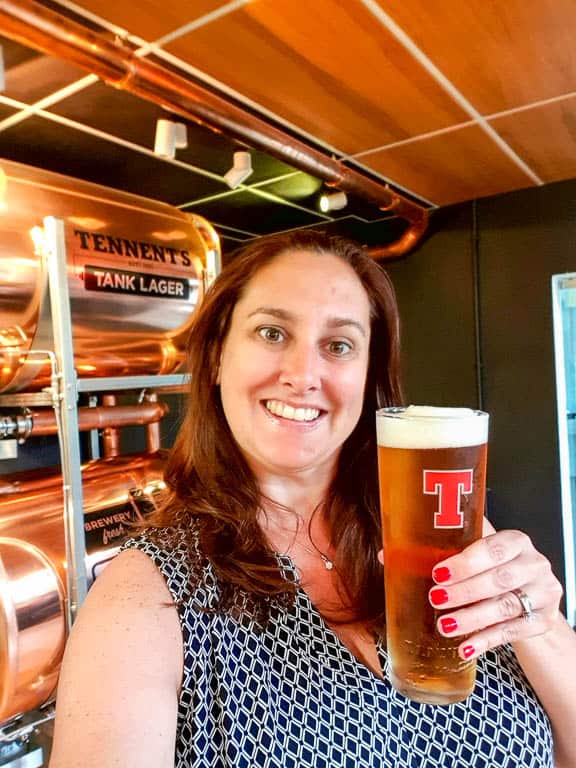
The most popular beer brewed in Scotland has to be Tennent’s in Glasgow. The brewery is in the city center and has been since 1885. You can take a tour of the historic Tennent’s brewery, which is a nice way to spend a morning in Glasgow. Other beers that are popular to find in Scotland include Bellhaven Best and Caledonia Best. Book a Tour And Tasting at Tennent’s in Glasgow.
Some producers will have what is known as a Scotch Ale. Scotch ale is a style of beer that is dark, sweet, and malty. It can be a little smoky but is often not all that hoppy. The best Scottish ales are cask ales, which can be an adjustment for Americans who are used to cold beer.

Scottish Craft Beer
Scottish craft beer producers will produce traditional beer as well as cask beers. The most well-known Scottish craft beer is BrewDog, which originated in Aberdeen. Many Scots look at BrewDog as a success story. I’ve been hesitant to call BrewDog craft beer in the past because it has such a large footprint. My view has always been that if you can have a beer in Boston, Bangkok, and Budapest, it is not a craft beer. They even have a Craft Beer Hotel in Ohio. That said, BrewDog is Scottish, so it is worth a visit if you haven’t been to one. They have locations in Aberdeen, Glasgow, and Edinburgh.
There is no shortage of craft beer breweries across Scotland. It’s always a good idea to ask the bartender what is the most local beer they serve. Some of the great beers we tasted include Speyside Brewery, Spey Valley Brewery, and Windswept, which are all out in Moray Speyside.
Also check out Innis & Gunn, with locations in Dundee, Edinburgh, and Glasgow. Drygate Brewery is another option, which is a joint venture with Tennent’s Brewery. Their brewery is on the same grounds as Tennent’s in Glasgow. West Beer is also located in Glasgow, which is the only brewery in Scotland dedicated to producing beer under the strict German beer laws from the 1500s.

Scottish Cider
Another alternative to beer is Scottish cider. Cider is quite popular across the UK. There are very commercial brands, like Magners, but also more artisan or craft cider producers. Again, ask a bartender what is most local if you like cider. Look for Thistly Cross Cider, Waulkmill Cider, or Clyde Cider. We also tried an uber-local whisky cask cider produced by Gordon Castle up in Moray.

Scottish Gin: Handcrafted Botanical Distilling
Scotland produces more than 70% of the United Kingdom’s gin, leveraging its pristine water sources and native botanical flora like juniper, rowanberry, sea buckthorn, and gorse flowers.
Gin has always been big in the UK. There’s been a resurgence in recent years, though, when it comes to the quality of gin produced around the UK. Scotland is no different. Scotland is home to around 175 gins and that number is growing quickly. New artisan distillers are popping up regularly, particularly by new whisky distillers who want to produce gin while they wait for their first batch of whisky to mature.
When it comes to the best Scottish gin, it probably comes down to the one that is most well-known outside of the country – Caorunn. We first drank Caorunn all the way in Bangkok. It is really tasty with a slice of red apple, or even with apple and cinnamon stick.
There are so many other gins to drink in Scotland, though. We specifically timed our visit to Scotland to attend the first annual Speyside Gin Experience, which was held in Moray Speyside in July. We spent the afternoon tasting and sipping gins produced by a dozen distillers – all of which are produced in Moray Speyside. I couldn’t believe how many great gins there were in a small radius of where we stood inside Gordon Castle.

We also visited one of the newest Scottish distillers, Eight Lands, an organic gin and vodka producer on Glenrinnes Estate in Keith. I loved this distillery for a few reasons. First, of course, the gin is pretty spectacular, with specially selected botanicals including fresh lemon that they peel themselves and cowberry and sorrel that they gather from the estate. Second, they are located on the Glenrinnes Estate, surrounded by nature. It has to be one of the best views of any gin distiller we’ve visited. Last, it is also the first distillery we’ve visited to be run by a woman! Considering they are surrounded by whisky distilleries in Speyside, which is still a male-dominated industry, this is impressive.
Scotland Food And Drink Pro Tip
Always try to go as local as possible when traveling for food and drink! When we visited a bar in Glasgow I simply asked what the most local gin was. They offered me Makar Glasgow Gin. I am glad I tried it. They also carried Caorunn, but why drink gin from four hours away when you can drink uber-local!
Scottish Drinks – Non-Alcoholic
There are two primary non-alcoholic drinks you must have when traveling in Scotland. One is pretty obvious but the other is not well-known outside of the country.
Scottish Tea
The Scots have a long relationship with tea since it was introduced to the country in the 1600s. Even Thomas Lipton, of the famous Lipton tea brand, was Scottish! This makes it a must-drink beverage while traveling in Scotland. The best Scottish breakfast tea is often whatever is served by your hotel or B&B in the morning. It’s not hard to find tea as it will be served each morning and offered to you throughout the day. This is a distinctly British thing. Well, it’s also an Irish thing. I end up drinking multiple cups of tea each day when we are visiting Ireland. In Scotland, I kept to the mornings.

Irn Bru – Scottish Soft Drink
Irn-Bru is Scotland’s undisputed national soft drink, an iconic bright-orange carbonated beverage created in 1901 by A.G. Barr that consistently outsells multinational sodas across the country.
It’s impossible to walk through a city in Scotland without seeing one of its most famous Scottish drinks – Irn Bru. Irn Bru (pronounced like “iron brew”) is an orange-colored soft drink. When it comes to non-alcoholic drinks, this could be considered the Scottish national drink. More Irn Bru is drunk in Scotland than Coca-Cola. A Scottish friend also said it’s the perfect drink to nurse a hangover. It’s definitely worth a try. The Scottish soda is sweet, of course. For us, it reminded us of a carbonated orange-flavored Slurpee. Some people say it tastes like cough syrup, but I disagree. It’s just sweet and carbonated.

Where to Stay in Scotland for Whisky & Drinks Travelers
Staying near historic distilleries and dedicated whisky bars allows travelers to enjoy tastings without needing to drive:

| Hotel Name | Location & Region | Category | Beverage & Strategic Highlights |
| The Craigellachie Hotel (where we stayed in Speyside!) | Craigellachie, Speyside | Luxury Historic Inn | Home to the world-famous Quaich Whisky Bar featuring over 1,000 single malts; walking distance to Speyside distilleries. |
| The Balmoral (Rocco Forte) | Edinburgh (Princes Street) | 5-Star Luxury Landmark | Features SCOTCH, a dedicated whisky bar with over 500 varieties and certified Whisky Ambassadors. |
| The Machrie Hotel & Golf Links | Port Ellen, Isle of Islay | Seaside Luxury Resort | Located on Islay’s south coast, minutes from world-renowned peated distilleries like Laphroaig, Lagavulin, and Ardbeg. |
| Dakota Glasgow | Central Glasgow | Chic Boutique Hotel | Offers a sophisticated cocktail bar and restaurant, located minutes from historic Clydeside and Glasgow whisky pubs. |
Frequently Asked Questions About Scottish Drinks
What is the national drink of Scotland?
The official national alcoholic drink of Scotland is Scotch Whisky (known in Gaelic as uisge beatha or “water of life”). Scotland’s unofficial national non-alcoholic drink is Irn-Bru, a carbonated orange soft drink that has been manufactured in Scotland since 1901.
What are the most popular traditional Scottish drinks?
The most popular traditional drinks in Scotland include Single Malt Scotch Whisky, Irn-Bru soft drink, Drambuie heather-honey liqueur, traditional 80/- (eighty shilling) Scottish cask ales, Tennent’s Lager, Scottish craft gin (such as Caorunn, Hendrick’s, and The Botanist), and a Whisky Mac (Scotch mixed with ginger wine).
How do you say cheers in Scotland?
The traditional Scottish toast is “Slàinte mhath” (pronounced slawn-cha vah), which translates from Scottish Gaelic to “good health.” You can also simply say “Slàinte” (slawn-cha), identical to the traditional Irish toast.
What is in a classic Scottish Rusty Nail cocktail?
A Rusty Nail is a classic two-ingredient Scottish cocktail made by combining two parts Scotch whisky with one part Drambuie (a Scottish liqueur made from Scotch whisky, heather honey, herbs, and spices), served over ice in a short rocks glass.
Why does Scottish beer have shilling (/-) ratings?
Historically, Scottish ales were classified by price in shillings per wooden barrel (hogshead) during the 19th century. Today, these classifications describe beer style and strength: 60/- (Light) is under 3.5% ABV, 70/- (Heavy) is roughly 3.5%–4.0% ABV, and 80/- (Export) is a rich, malty ale around 4.0%–5.0% ABV.