
We’ve been traveling to Lisbon Portugal for years. Most travelers know Lisbon as a city on the water, with classic yellow trams and tile-fronted buildings creeping up steep hillsides. It is all those things and more.
For us, over the years, it’s been a city to explore for some of the best Portuguese food! That means we are always researching and updating our Lisbon Food Guide, so we can share our top tips on what to eat in Lisbon.
*This post contains compensated links. Find more info in my DISCLAIMER. As an Amazon Associate, I earn from qualifying purchases.
Quick Facts: What To Eat In Lisbon
| Category | Lisbon Norm & Insight | Practical Foodie Takeaway |
| Top Must-Try Bites | Pastel de Nata, Bifana, Bacalhau | Start mornings with custard tarts and grab quick pork bifanas for lunch. |
| Average Casual Meal Cost | €10 to €18 (~$11 to $20 USD) | Covers a main dish (prato do dia), small beer/wine, and an espresso at a traditional tasca. |
| Seafood Feast Budget | €40 to €60+ per person | Fresh shellfish and prawns at institutions like Ramiro are priced by weight (per kilo). |
| Bread & Olives Couvert | Not Free (€2.00 to €5.00) | Items placed on your table upon sitting down are charged only if you eat them. |
| Payment Reality | Multibanco vs. International Cards | Traditional tascas often accept cash only or Portuguese cards; always carry €20–€30 cash. |
| Lisbon Topography | City of Seven Hills | Wear comfortable walking shoes with grip; cobblestones (calçada) are slick when wet. |
Table of Contents
Eating Typical Portuguese Food In Lisbon
We’ve stayed in hotels and apartments across the city, in some of the more touristy areas, and in some neighborhoods surrounded by locals.
We’ve eaten at one of the most famous restaurants in Portugal, and at little bars that only serve liquor and Portuguese sandwiches. And, because we generally travel for food and drink, Lisbon is one of our absolute favorite cities. There’s so much variety when it comes to Portuguese alcohol and beverages too!
Over the years, we’ve visited Lisbon at least a half dozen times—we even seriously considered moving here before we ended up living in Spain! We love virtually everything about the city, except perhaps hiking up those steep hills after a four-course seafood lunch. Lisbon remains one of our absolute favorite European cities to return to for deep culinary exploration, and we jump at every chance to revisit our favorite tascas and discover new neighborhood spots.
We continue to return to some of our favorite Lisbon restaurants and are always exploring to learn about new places to eat.
In this Lisbon blog post, we talk about Portuguese cuisine, including the traditional Portuguese foods you must eat in Lisbon.
We also share our recommendations for some of the best places to eat in Lisbon for each of these dishes.
Traveling to Portugal? Check out our comprehensive Portuguese Food Guide, with a list of the 28 traditional Portuguese dishes you must try!

Looking for more Lisbon Travel Tips? Check out our Lisbon Travel Guide
Taking A Food Tour In Lisbon
People often ask us how we find great food in a city we’ve never visited. In addition to doing our own research and asking friends, we always take a food tour. Not only will you learn what to eat and where, but food tours are also a great way to learn your way around a city.
There are lots of great food tours in Lisbon and choosing the right one is tricky. We are big fans of Devour Tours. Devour Tours does a great job of explaining the food and drink in a city.
They have the local knowledge to discover off-the-beaten-path bars and restaurants only locals go to. Over the past decade, we’ve easily been on a dozen Devour food tours across Spain, Italy, and Portugal.
In Lisbon, Devour Tours offers a mix of food tours and sightseeing tours. Tour prices range from $70 to $130 per person. Most of Devour’s tours max out at 12 guests making it a more enjoyable experience. Here are the food tours Devour currently offers in Lisbon.
Tastes & Traditions of Lisbon Food Tour
Lisbon at Sunset: Petiscos, Food & Wine Tour
Lisbon Food & Fado Tour: An Evening Out in Mouraria & Alfama

Portuguese Cuisine
Lisbon is one of our favorite food and drink destinations. Although the city is becoming a lot more popular with tourists, particularly for Europeans looking for a city break, there is still so much authenticity in the cuisine.
First, it helps to know what is Portuguese cuisine.
Portuguese dishes are typically hearty, with a focus on local and fresh ingredients. This means a lot of fish, being a country that is virtually surrounded by water.
This is also due to the country’s maritime history. It also means a lot of pork, well, because pork is tasty. Eating in Lisbon includes specific Lisbon specialties, but it’s also a great city to eat dishes that are inspired by the rest of the country as well.

Foodies Guide To Lisbon
Our foodie’s guide to Lisbon focuses on what dishes to eat in Lisbon, with some recommendations on where to eat these particular dishes.
Because Lisbon is becoming a lot more popular, it’s important to do your research before arriving in Lisbon.
There are a lot of tourist-focused restaurants in the center of Lisbon. Some of them might be decent. Others are real tourist traps offering dishes that are more Spanish than Portuguese.
Yes, we’ve seen menus along Rua da Prata offering lunch deals with paella and sangria – these are not Portuguese dishes! This can also happen in the Alfama district, one of the more touristy in the city.
Recommendations On Where To Eat In Lisbon – TripAdvisor Lisbon Restaurants
What To Eat in Lisbon – 13+ Must Eat Dishes
Here are our recommendations for some of the must-eat dishes in Lisbon. Some of these may be considered famous Portuguese food or dishes.
Others may not be very well known outside of Portugal. Here’s our list of what to eat in Lisbon.

Pastel de Nata – Portuguese Custard Tart
The pastel de nata is Lisbon’s most iconic sweet pastry, featuring crisp, flaky puff pastry cups filled with caramelized egg custard.
When we are asked the question: What is Lisbon famous for when it comes to food? There’s only one dish that comes to mind, and that’s the pastel de nata.
It’s hands down the most famous pastry to eat in Lisbon. And, that’s saying something because Lisbon offers amazing pastries!
The Portuguese egg tart, or pastel de nata, is a round, puff pastry filled with an egg-based custard. The custard is made with egg yolks, sugar, cream or milk, and other seasonings including cinnamon, vanilla, or lemon zest, depending on the recipe from the bakery.
Normally there are shakers of cinnamon or sugar on the counter to top the pastry. Go for the cinnamon!
Most claim that the original recipe dates to the 16th Century when nuns at local convents would make them. Now, you can find them all over Lisbon.
Although most locals enjoy a pastel de nata for breakfast, they are eaten throughout the day. They make a perfect mid-morning or pre-dinner Portuguese snack as well. Normally a pastel de nata costs around €1.30 to €1.50 at benchmark bakeries like Manteigaria and Pastéis de Belém. Pair it with a coffee or a class of port wine.
Our favorite is at Manteigaria Fábrica de Pastéis de Nata on Rua de Loreto 2.
Check out our complete guide to the Best Lisbon Custard Tarts.

Leitão – Portuguese Roast Suckling Pig
Leitão is slow-roasted suckling pig celebrated for crackling, shatteringly crisp skin and juicy, peppery, garlic-rubbed pork.
Many of the most traditional Portuguese dishes incorporate pork in some way. But one dish makes pork the main feature. Leitão is a suckling pig, normally served as a sandwich or as a platter. A suckling pig means a young pig.
It can be a bit difficult to find really good leitão in the Lisbon city center because it is a challenge to prepare.
The best we’ve had is from Henrique Sá Pessoa’s stall at Time Out Market. It’s priced around €15 to €17, but well worth it for the exceptional crackling. Sometimes the local Portuguese restaurants also serve leitão as part of a set lunch menu.

Portuguese Bifana Sandwich
The bifana is Portugal’s definitive cheap eat: thinly sliced, tender pork loin simmered in garlic, white wine, and lard, piled onto a crusty white roll.
When it comes to the best cheap eats in Lisbon, the bifana sandwich has to be some of the best food in Lisbon. And surprise, surprise, we learned about bifanas from Anthony Bourdain.
It’s a simple sandwich of seasoned and marinated pork loin on a soft roll served with mustard and spicy chili oil. You can find bifanas at many Lisbon bars and cafes throughout the city.
The perfect bifana should be tender and flavorful and served on a fresh, soft roll. Expect to eat it standing up.
Wash it down with a cold beer or a fresh glass of Vinho Verde, the famous Portuguese “green wine.” Our favorite is from O Afonso das Bifanas: Rua de Madalena 146. At classic standing counters like As Bifanas do Afonso, expect to pay around €3.00 to €3.50 for a hot, fresh sandwich.”
Check out our guide on how to find the best bifana in Lisbon.

Prego no Pão – Portuguese Steak Sandwich
The prego is a garlicky, pan-seared beef steak sandwich served warm on a soft roll, famously ordered as “dessert” after a seafood feast.
Another Portuguese sandwich option, the Prego can normally be found at the same bars where bifanas are on the menu.
It’s a piece of beef steak, grilled with garlic and served on a soft bun, normally with mustard. This is the sandwich we are eating in the photo above, as a dessert from our favorite seafood restaurant in Lisbon!
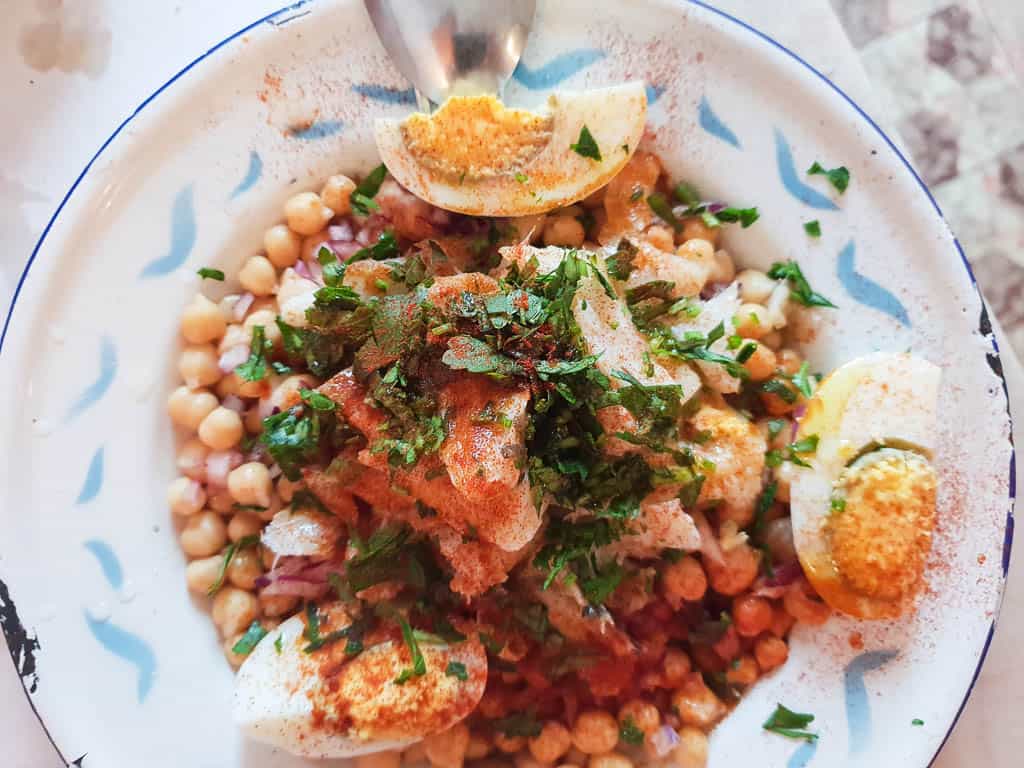
Bacalhau – Salted Codfish
Bacalhau (salted and dried Atlantic cod) is the undisputed national culinary obsession of Portugal, prepared in hundreds of distinct regional recipes.
If one dish could be considered the national dish of Portugal, it could be bacalhau. It’s sort of a national obsession. Not just in Portugal but in Spain where we live as well.
Bacalhau is a salted codfish. It can be served in a variety of ways, including as a simply sautéed or grilled fish.
Bacalhau is most commonly eaten in Lisbon fried in a croquette or served cold in a salad, often on top of garbanzo beans. This is one of the easiest dishes to find on the menus at many places to eat in Lisbon.
Another way to eat bacalhau in Lisbon is bacalhau à brás, which pan-fries the salted codfish with shredded potatoes (or fried potatoes like french fries) and scrambled eggs.
It’s perfect Portuguese comfort food. The best bacalhau à brás we’ve had was at Bistro4 at Porto Bay Liberdade in Lisbon.

Caldo Verde – Traditional Green Soup
Caldo verde is Portugal’s ultimate comforting soul food, blending a velvety potato-and-garlic broth with finely shredded dark kale and sliced chouriço.
Caldo verde is not a very photogenic soup. It’s not a Portuguese dish I crave when traveling in Lisbon. But, every time I eat this soup I find myself drawn to it, like comfort food. I am not entirely sure why.
The base of the soup is potato and a leafy green vegetable like kale. A warm bowl of caldo verde typically costs around €2.50 to €3.50 at a neighborhood tasca. It’s simple and tasty.

Alheira – Smoked Bread and Poultry Sausage
Alheira is a uniquely soft, garlicky smoked sausage stuffed with poultry and bread, historically created by Portuguese Jews to escape Inquisition persecution.
Alheira is a smoked sausage with a bread filling, making it softer than traditional sausage. Traditionally it was made with chicken.
This was so that the Jewish people in Portugal centuries ago could pretend to be Catholic, to avoid persecution. If people saw them eating sausage, it must be pork which meant that they were not Jewish.
Back then it was always made with chicken, although now sometimes it is actually made with pork.
The alheira is probably more popular in the north of Portugal, but if you see it in Lisbon order it! It’s one of my favorite things to eat in Portugal. It is often served with some vegetables or cabbage, potatoes, and a fried egg.
There is just a different texture to this sausage that is totally tasty. We ate a good version at O Martinho da Arcada e Lisbon on Praça do Comércio 3. They served it on their lunch menu of the day, so it might not be an everyday thing.

Frango Piri Piri – Spicy Grilled Chicken
Frango piri piri is charcoal-grilled or rotisserie-cooked whole chicken basted in a fiery African bird’s eye chili, garlic, and citrus marinade.
This is probably one of the most famous Portuguese dishes, even if people don’t recognize it as being Portuguese. It’s a Portuguese dish with African roots, with seasoning coming from Mozambique and Angola.
The popularity of Nando’s chicken has made this grilled or rotisserie chicken famous. The chicken is served with a Piri Piri or a spicy hot sauce. The hot sauce can be HOT! Be prepared. Served with french fries and a sample salad, it’s one of our absolute must eats in Lisbon.
Expect to pay around €7.50 to €9.00 for a half chicken and €14 to €17 for a whole chicken with fries and salad. A half chicken is a healthy portion for one person.
We ate a fabulous version of piri piri chicken from Frangasqueira Nacional in Principe Real. Frangasqueira Nacional is more of a takeaway option, although there are two tiny tables inside.
Or, there is Bonjardim, which is a good option for reliable food in the uber-touristy Restauradores neighborhood. Bonjardim specializes in rotisserie-style chicken Piri Piri, with a simple menu of chicken and side dishes.

Cozido à Portuguesa – Traditional Meat and Vegetable Stew
Cozido à Portuguesa is a rich, slow-simmered weekend stew ladling assorted cured sausages, pork cuts, beef, cabbage, carrots, and white beans over rice.
This is probably the most typical Portuguese food and doesn’t always find its way onto a list of what to eat in Portugal.
It might be a bit much for typical travelers, but for food travelers, it’s just the sort of dish you should track down.
The base of the dish is cabbage (or collard greens), white beans, and rice, topped with a meat-heavy stew.
The stew has a delicate flavor and is a perfect winter dish. The stew normally includes sausage, black sausage, and various pork bits, including offal, or the organs of the pig.
It’s not for the faint of heart, but it’s worth it to try at least once in Lisbon. You can find cozido at many Lisbon bars as a plate of the day, normally for around €9 to €13 as a hearty lunch special. I love cozido with a nice glass of Portuguese red wine, while Eric prefers it with an ice-cold Portuguese beer.

Gambas com Alho – Sizzling Garlic Shrimp
Gambas com alho arrives sizzling in fragrant olive oil infused with lots of fresh garlic, dried chili flakes, and fresh cilantro, meant for dipping warm crusty bread.
One of the more common dishes at seafood restaurants in all of Portugal, and even in Spain, is garlic shrimp. They generally come to the table sizzling in olive oil and garlic.
The Portuguese version includes a little bit of chili pepper and the garlicky oil is perfect for sopping up with fresh, warm bread. Although it is easy to find this dish at restaurants across Lisbon, our favorite comes from Cervejaria Ramiro Lisbon.
Cervejaria Ramiro is one of the best restaurants in Lisbon. We first learned about it from the late Anthony Bourdain. Every time we visit Lisbon, we eat here at least twice.

Marisco – Portuguese Shellfish and Prawns
Lisbon’s shellfish halls serve some of the freshest Atlantic seafood in Europe, keeping preparations simple with olive oil, sea salt, garlic, and fresh lemon.
Bordered on two sides by water, it’s no surprise that seafood including shellfish is a HUGE part of Portuguese cuisine.
We’ve been fortunate to enjoy delicious clams, mussels, and oysters around the World, but there’s something about the simplicity of how the Portuguese prepare shellfish.
Using nothing more than olive oil, salt, pepper, and lemon, the Portuguese let the natural flavors of shellfish be the star.

Sardinhas Assadas – Grilled Atlantic Sardines
Sardinhas assadas are whole fresh sardines charcoal-grilled over open embers, seasoned with coarse sea salt, and served whole alongside boiled potatoes or over thick slices of rustic bread.
We first got the taste for sardines while living in Spain. It’s strange to write that considering most Americans don’t like them. Thankfully, much like their neighbors, the Portuguese love sardines.
Known locally as sardinhas, these tasty fish are a mainstay of Portuguese cooking. In Portugal, sardines are grilled with a little olive oil, salt, and pepper. It’s also very common to find them canned.
Cataplana de Marisco – Seafood Stew
Cataplana de marisco is an aromatic, tomato-, white wine-, and garlic-braised shellfish stew slow-cooked inside a clam-shaped, hinged copper pan.
Cataplana is a Portuguese seafood stew cooked in a large copper pan and served with rice or chips. This dish is traditionally prepared in Algarve, to the south.
You can find it in Porto Brandão, a small fishing town across the river from Lisbon.
You can actually take a ferry to reach the village. In addition to a mix of clams and shrimp, the stew is made with garlic, olive oil, onion, and white wine.

Where To Eat In Lisbon
There are so many great places to eat in Lisbon. We’ve also made mention of a few places above that are known for particular dishes.
Here, I will recommend a couple more places to go for consistently good food with a focus on traditional Portuguese dishes.
Most of these are also located in the city center, where many travelers end up, so they are good options for reliable cuisine.
Cervejaria Ramiro, Av. Alm. Reis nº1 – H, one of our absolute favorite restaurants in Lisbon for seafood. It is open all day, so try to go during off hours to avoid long lines. Be prepared to spend about €80 to €110+ for two people depending on shellfish weights. It’s totally worth it.

O Martinho da Arcada e Lisboa is on Praça do Comércio 3, surrounded by touristy restaurants. Look for their cheap lunch specials in the casual front bar, or there is a more formal dining room in the back, with higher prices.
A Merendinha do Arco (Rua dos Sapateiros 230) is hidden under an archway just steps from Rossio Square, this cozy, long-standing tasca is a true escape from the surrounding tourist traps. It’s tiny and packed with local office workers and cab drivers dining family-style along communal tables. Order the sizzling garlic prawns (gambas com alho), crispy cod fritters (pataniscas de bacalhau) served over warm bean rice, or their daily grilled sardines. It’s affordable, no-frills Portuguese home cooking at its finest. Arrive slightly before 12:30 PM or after 2:30 PM to snag a seat.
Time Out Market is an indoor food court packed with tons of tasty food stalls. From the Time Out magazine people, the food court is located at Mercado da Ribeira at Cais do Sodré. It’s one of the best places to try lots of different Portuguese food all in one place.
FAQs – What To Eat In Lisbon Portugal
What is Lisbon famous for food?
Over the past ten years, we’ve made a dozen trips to Lisbon. It’s easily one of the best food cities in the world. What makes it such a great food city is the volume of famous dishes in Lisbon. From our experience, I’d say three of the most famous foods in Lisbon are seafood, pastel de nata, and the bifana sandwich.
What is typical Portuguese food?
Portuguese food, like many other cuisines, is regionalized. In different parts of Portugal, there are different versions of the same dish. That said, Portuguese food is heavily based on seafood, especially cod fish. Beef, Portugal produces lots of beef, is also very popular. You’ll find a lot of soups and stews in Portuguese cooking.
Is there any fine dining in Lisbon?
Absolutely yes! Lisbon’s high-end dining scene is exceptional and has grown significantly since Portugal earned its own standalone Michelin Guide. There are roughly 16 to 18 Michelin-starred dining rooms across the capital—anchored by two-star icons like Belcanto by José Avillez in Chiado, alongside one-star innovators like CURA, EPUR, and the vegetarian-focused Encanto. All of these restaurants showcase seasonal tasting menus paired with stellar Portuguese wines.
Do You Have to Pay for Bread and Olives Placed on the Table in Lisbon?
Yes. In Portugal, this is called the couvert. When you sit down, waitstaff will typically set down bread, olives, butter, cheese, or small sardine pâtés. Unlike in American restaurants, these items are not complimentary. If you eat them, they will appear on your final bill (usually €2.00 to €5.00 total). If you do not want them, simply give a polite wave of your hand and say “não, obrigado,” or leave them untouched on the side of the table and you will not be charged.