
If there is one pastry that epitomizes Lisbon, it is the pastel de nata—the iconic Portuguese egg custard tart known around the world.
I fell in love with these pastries on our very first trip to Portugal over a decade ago, quickly finding myself eating them at least once a day (and often more). After visiting Lisbon more than a half dozen times and sampling tarts across the city, I consider myself a dedicated aficionado of Lisbon custard tarts.
In this curated Lisbon food guide, I share the history of the pastry, how to order them correctly in Portuguese, and an honest, tested breakdown of where to find the absolute best pastéis de nata in Lisbon—along with a few famous spots you can safely skip.
*This post contains compensated links. Find more info in my DISCLAIMER. As an Amazon Associate, I earn from qualifying purchases.
Quick Facts: Lisbon Custard Tarts
| Detail | What to Know |
| Singular / Plural | Pastel de nata (one tart) / Pastéis de nata (multiple tarts) |
| Typical Cost | €1.20 – €1.60 per tart |
| Best Way to Enjoy | Warm from the oven, dusted with ground cinnamon, paired with an espresso (bica) |
| Our Top Pick | Manteigaria (Chiado or Time Out Market) |
| The Historic Original | Pastéis de Belém (in Belém, operating since 1837) |
| How to Spot a Great Tart | Ultra-flaky, laminated, non-greasy crust with a caramelized, blistered top and a wobbly, non-gelatinous center |
Table of Contents

What is the Pastel de Nata Lisbon
The Portuguese egg tart is a round, puff pastry filled with egg-based custard. The custard is made with egg yolks, sugar, cream or milk, and other seasonings including cinnamon, vanilla, or lemon zest, depending on the recipe from the bakery.
When warm the filling should be creamy and a bit runny, but even when cold there should be a softness to the custard.
The custard should be darkened on the top from the oven, but not burnt. Normally there are shakers of cinnamon or sugar on the counter to top the pastry. Go for the cinnamon!
Most claim that the original pastel de nata recipe dates to the 16th century when nuns at local convents would make them. Now, you can find them all over Lisbon. Although most locals enjoy a pastel de nata for breakfast, they are eaten throughout the day.
They make a perfect mid-morning or pre-dinner snack as well. My rule when traveling in Lisbon is to eat pasteis de nata early and often.
Normally a pastel de nata costs between €1-1.15 per custard tart. Some cafes might charge a few cents more to sit down. This makes them a snack that is easy on the budget.
Check out our round-up of the Best Portuguese Desserts Recipes to learn how to make paste de nata and other desserts at home.

What Makes a Great Lisbon Custard Tart?
Obviously, everyone likes something different when it comes to Portuguese custard tarts. We visited a lot of Lisbon pastry shops this trip, sometimes eating several pasteis de nata in one day.
We found our favorite, which I will share below, but quickly learned how to tell the difference between a good and a not-so-good Portuguese egg custard cup.
Crust: The Lisbon custard tart should be light and flaky, not soggy, with a taste of butter. The bottom should also be light, and not doughy.
Filling: Thick and creamy, not too sweet, and a little runny when warm. Some are more yellow-colored when more eggs are used.
Top: Dark and caramelized but not burnt, although you can ask for one that is more burnt, which tastes like caramelized sugar or toasted marshmallow.
Paring: This may be controversial, but pair a pastel de nata with one of the most famous drinks in Portugal, port wine. You won’t be disappointed!
Traveling to Portugal? Check out our comprehensive Portuguese Food Guide, with a list of the 28 traditional Portuguese dishes you must try!

Where to Find the Best Lisbon Custard Tarts
Although the pastel de nata can be found at pastry shops, or pastelarias, across the city. Over the years, we’ve eaten these pastries at some of the best and most well-known bakeries in Portugal.
We’ve also eaten them at whatever neighborhood baker or bar that was close to our hotel or apartment rental.
Chances are that even if you don’t track down one of these famous spots for pasteis de nata you will find some good ones.
Many of the spots below should have them warm as well. This is more difficult for a traditional mom-and-pop neighborhood cafe.
If you take a Lisbon food tour, you are almost guaranteed to try a Lisbon custard tart. Food tours are normally run by local food experts, and they can probably recommend even more places to eat pasteis de nata in Lisbon.
Lisbon Food Guide Pro Tip: Know the Lingo!
Portuguese pronunciation and grammar differ significantly from Spanish. When ordering custard tarts in Lisbon, keep these language tips in mind:
- Pastel de nata: Singular (one custard tart). Example: “Um pastel de nata, por favor.”
- Pastéis de nata: Plural (multiple custard tarts). Example: “Dois pastéis de nata, por favor.”
- Pasteles de nata: Incorrect. This is a common mistake made by travelers applying Spanish pluralization rules.
- Pastéis de Belém: A legally protected name reserved exclusively for tarts baked at the historic bakery in Belém.

Pastéis de Belém (Santa Maria de Belém)
Pastéis de Belém is Portugal’s most historic bakery, baking the original monastic custard tarts according to a protected 1837 secret recipe.
Although we’ve traveled to Lisbon multiple times, up until the latest trip we never trekked out to Santa Maria de Belém to try these particular Portuguese custard tarts.
It’s only a half-hour away, but when there are plenty of perfectly good Portuguese desserts in the city center, it seems unnecessary. But, we’ve heard so many stories about these particular pastel de nata that we had to make the journey.
Why are the Pasteis de Nata Belem so well-known? First, the bakery was established in 1837 making it one of the oldest continuously running bakeries in Lisbon.
They began baking the original Pastéis de Belém based on a secret recipe handed down to them from the nearby Jeronimos Monastery.
Second, this recipe remains a strictly guarded secret. They make the pastries daily in a “Secret Room” although you can see the production through big windows.
Not sure where they do the secret stuff. In fact, these tarts are known as a Pastéis de Belém (a trademarked name) and not a pastel de nata.
Visit for the historic atmosphere and the experience, but don’t expect it to surpass modern boutique bakeries.
- Location: Rua de Belém 84-92 (Belém)
- Price: €1.40 per tart

Is Pastéis de Belém Worth The Trip?
So, is it worth the trek? Maybe. I would recommend it for the experience, but would not say it was my favorite tart.
We had five between the two of us (!) along with a glass of port, which was nice. The bottom of the tart was too hard and crunchy for me, although the filling was nice.
The cafe is huge! There are several lines, some for takeaway. There is one line to grab a seat in one of the dining rooms, which collectively hold up to 400 people. The price is about the same and after the trek out there, it’s nice to sit and relax.
Where To Find Pastel de Belem Lisboa
Pasteis de Belem Lisbon is located at Rua de Belém, 84-92. The shop is outside the center of Lisbon, close to the monastery that provided the original recipe.
There are several buses that run along the water from the Praca do Comercio. The journey takes about 30 minutes. They are open from 8 am to 11 pm seven days a week.
The Belem district is actually a nice, historic neighborhood to wander. Be prepared to cue on weekends and during the summer.
If possible, try to visit mid-week. We visited midday on a Friday and walked right into a table with no problem. Or, if choosing takeaway, enjoy it in the park or along the waterfront just a few blocks away.

Pastelaria Aloma (Campo de Ourique & Chiado)
Pastelaria Aloma is a multi-award-winning Lisbon bakery famed for traditional tarts with balanced sweetness and a flaky, hand-rolled shell.
Pasterlaria Aloma won best nata in Lisbon several times over the last few years. Their original location in Campo de Ourique opened in 1943 but now they have a few locations in Lisbon.
Their original was a good 30-minute walk from our apartment in Principe Real, which means it’s a good 45-minute walk from where many travelers stay.
But, lucky us, they opened a new location in Chiado during our visit. I think we actually stopped by on their very first day. They were still doing construction on Friday, but by Saturday, they opened.
These were good. Aloma served the pasteis a little cold, the crust was flaky on the sides, but a little dough-like on the bottom. The custard had a good consistency, not too yellow, and slightly sweet. Good, but not my favorite.
- Price: €1.30 per tart
- Location: Rua Francisco Metrass 67 (Campo de Ourique) & Largo do Calhariz 2 (Chiado)
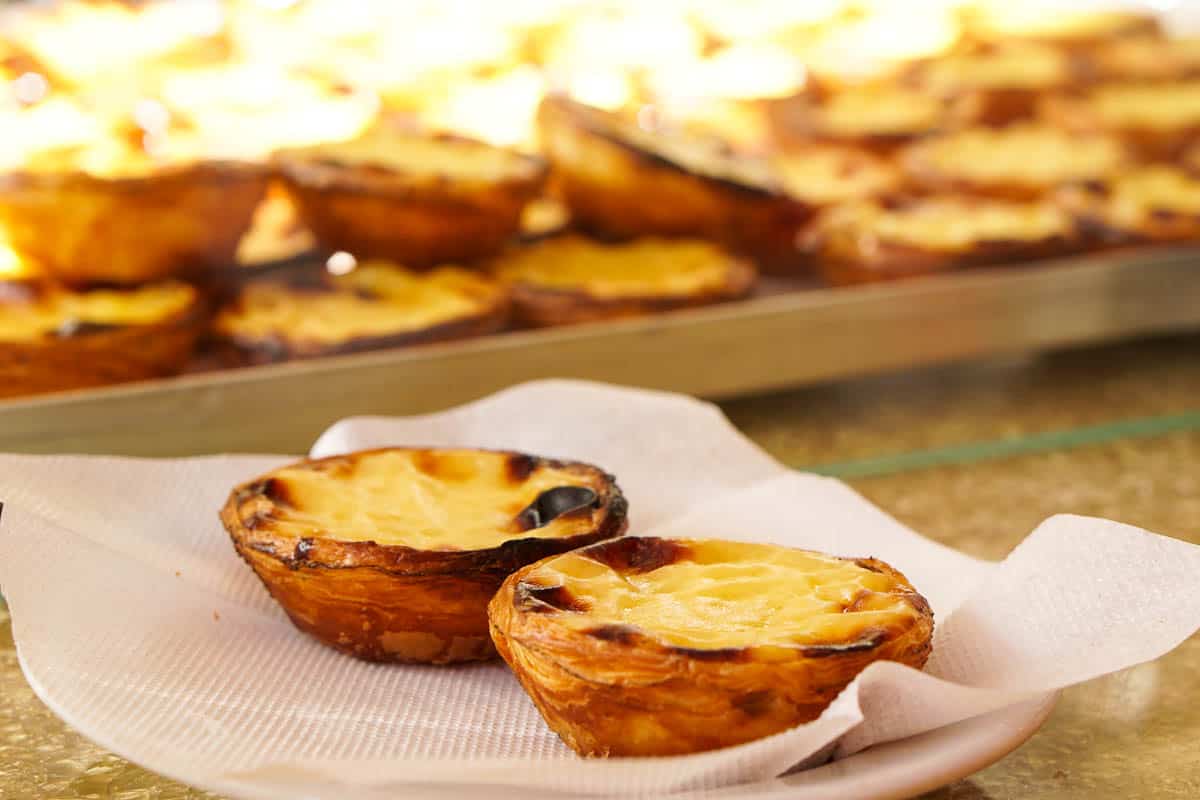
Manteigaria Fábrica de Pastéis de Nata (Chiado & Cais do Sodré)
Manteigaria produces Lisbon’s best pastéis de nata, known for an ultra-crisp, whisper-thin laminated crust and a velvety, warm custard that is not overly sweet.
Manteigaria Fábrica de Pastéis de Nata in the Chiado neighborhood is a pastel de nata factory. All day, every day, you can see bakers in the background making some of the most famous egg tarts in Lisbon.
Supposedly, when a hot batch arrives at the counter they ring a bell. We never heard the bell ourselves, but every time we visited the tarts were warm.
Even the building itself is lovely, with Art Nouveau architecture, although the shop itself is relatively new and modern.
We’ve visited their second location as well, located in the Time Out Market (Mercado da Ribeira). Marcelo took care of there, serving up some egg tarts with a little personality.
The Lisbon custard tarts are just as good, but it is missing the atmosphere of the original location. As for the original location, head toward the back of the shop to see the pastry chefs at work.
This was hands down my favorite Portuguese custard tart we tried. It was the first of this trip, but we also returned at the end to make sure.
This was hands-down my favorite Portuguese custard tart in Lisbon. The custard is light, creamy, and served warm, while the pastry shell is exceptionally flaky without feeling greasy or doughy.
- Location: Rua do Loreto 2 (Chiado) & Mercado da Ribeira (Time Out Market)
- Price: €1.30 per tart
Where Is Manteigaria Fábrica de Pastéis de Nata
Manteigaria Fábrica de Pastéis de Nata is located at Rua de Loreto 2. They are open from 8 am to midnight seven days a week.
This shop is small, with, unfortunately, no tables. They only offer takeaway, or you can stand at the counter. If you only have one day in Lisbon, this is the must-eat pastel de nata!
Fábrica da Nata (Praça dos Restauradores & Rua Augusta)
Fábrica da Nata is a convenient downtown bakery chain offering warm custard tarts in spacious, sit-down dining rooms.
With prominent locations along Praça dos Restauradores and Rua Augusta, Fábrica da Nata caters directly to central foot traffic. The shops feature grand chandeliers, comfortable seating, and an overhead conveyor track that transports trays of freshly baked pastries to the counter.
Because of the high turnover, you are almost always guaranteed a warm tart straight from the oven. The crust delivers an audible crunch, though the bottom pastry layer is occasionally thicker than what you find at Manteigaria. It is an easy, reliable stop while exploring central Baixa.
- Location: Praça dos Restauradores 62-68 / Rua Augusta 275
- Price: €1.30 per tart

Where Else to Eat Pastel de Nata Lisbon
Did I mention how many Portuguese custard tarts we’ve eaten to research this post? We visited a few other places that often are on people’s must-eat in Lisbon list.
Some of these are newer and some are ancient Lisbon bakery establishments. I am mentioning them because we visited, but would not say they are my favorite places for pasteis de nata in Lisbon.
Confeitaria Nacional & Historic Pastelarias
Confeitaria Nacional, established in 1829, is Lisbon’s oldest operating pastry shop, known more for its ornate 19th-century interior than for having the city’s crispest egg tart.
Located on Praça da Figueira, Confeitaria Nacional is worth stepping inside purely to admire the mirrored wood paneling, marble counters, and traditional Portuguese holiday cakes (like Bolo Rei). However, their pastéis de nata are often baked off-site and served cool, resulting in a heavier, denser crust.
Similarly, neighborhood coffee shops like Chiado Caffe are great for an espresso, but their tarts tend to use heavier egg-binder formulas and sit under display glass longer.
Chiado Caffe
Chiado Caffe on Rua do Loreto 61, is a good spot to grab a coffee. We visited to do just that and tried one of their pastel de nata because we happened to be there.
Their pasteis de nata was some of the more yellow, egg-heavy of the pasteis we tried. It also was a little doughy and served cold.

Pastel de Nata Recipe
Yes, the pastel de nata has to be the most famous of Portuguese pastries. It’s a pastry I would love to learn how to make at home.
I haven’t tested out a pasteis de nata recipe, but I would recommend a Portuguese cookbook to learn. I did some research to find a Portuguese custard tart recipe that wasn’t too difficult.
All of the recipes I reviewed had the same ingredients in common: eggs, sugar, milk, and cinnamon. Some, like this one, used store-bought pastry sheets, making it even easier to make these pastries at home.
While traveling in Lisbon, it might be worthwhile to book a cooking class to learn how to master a Portuguese egg tart recipe at a real Portuguese bakery.
Check out our recommended Lisbon Food Tours And Cooking Classes.
Where to Stay in Lisbon for Food Lovers
Whether you are staying for a weekend of petiscos crawls or settling in for a week-long culinary exploration, choosing the right neighborhood is essential. Here are our top accommodation recommendations in Lisbon:
- Apartments & Extended Stays (Best for Longer Trips): When staying a week or more, booking a serviced apartment gives you extra space and a kitchen for market finds. We recommend Lisbon Serviced Apartments – Baixa Castelo for easy access to tascas and bakeries. (Browse all Lisbon Apartments on Booking.com)
- Luxury & Grand Stays: For five-star service and refined dining, the Four Seasons Hotel Ritz Lisbon is an iconic classic overlooking Eduardo VII Park (check out their rooftop running track!). For a quieter luxury base just off the grand boulevard, PortoBay Liberdade offers a superb rooftop and indoor pool, while the Sheraton Lisboa Hotel & Spa provides reliable comfort near Saldanha.
- Central Mid-Range Boutique: My Story Hotel Tejo offers stylish, comfortable rooms in the heart of historic Baixa, placing you steps from traditional pastelarias and tram lines.
- Riverside & Food Market Base: Corpo Santo Lisbon Historical Hotel sits right by Cais do Sodré, placing you a two-minute walk from Time Out Market and the seafood tascas along the Tagus River.
- Browse All Options: Check current rates and availability for all Lisbon hotels on Booking.com.
Frequently Asked Questions About Lisbon Custard Tarts
What is the difference between a pastel de nata and a pastel de Belém?
The name Pastel de Belém is a legally trademarked name reserved exclusively for tarts baked at the historic Fábrica de Pastéis de Belém using the original 1837 monastic recipe. All other custard tarts baked across Lisbon, Portugal, and the world are called pastéis de nata.
Are pastéis de nata eaten warm or cold?
While pastéis de nata can be eaten cold or at room temperature, they are best enjoyed warm shortly after baking. When warm, the puff pastry retains its crisp, shatteringly flaky texture, and the custard filling is soft, creamy, and slightly runny.
How do you eat a pastel de nata like a local?
Locals typically eat pastéis de nata at the bakery counter paired with a bica (a shot of hot espresso) to balance the sweetness of the custard. Most pastelarias place shakers of powdered cinnamon (canela) and icing sugar on the counter; dusting a light layer of cinnamon over the blistered custard top is the traditional way to enjoy it.
How much do custard tarts cost in Lisbon?
A pastel de nata in Lisbon typically costs between €1.20 and €1.60 at specialty bakeries and neighborhood pastelarias. Prices are slightly higher at airport terminals or sit-down tourist cafes along main pedestrian boulevards, but they remain an affordable everyday treat.
How many days do pastéis de nata stay fresh?
Pastéis de nata are best eaten the day they are baked. While they will keep in an airtight container at room temperature for 1 to 2 days, the pastry crust absorbs moisture from the custard and loses its crispness. To refresh day-old tarts, reheat them in an oven or air fryer at 180°C (350°F) for 4 to 5 minutes rather than using a microwave.
Great list! We loved the Pastel De Nata and sampled a number of these!