There is a saying that goes, “No one wants to see how the sausage is made”. When it comes to mortadella, though, I was desperate to find out how it is made in Italy and its story. The question is what is mortadella anyway?
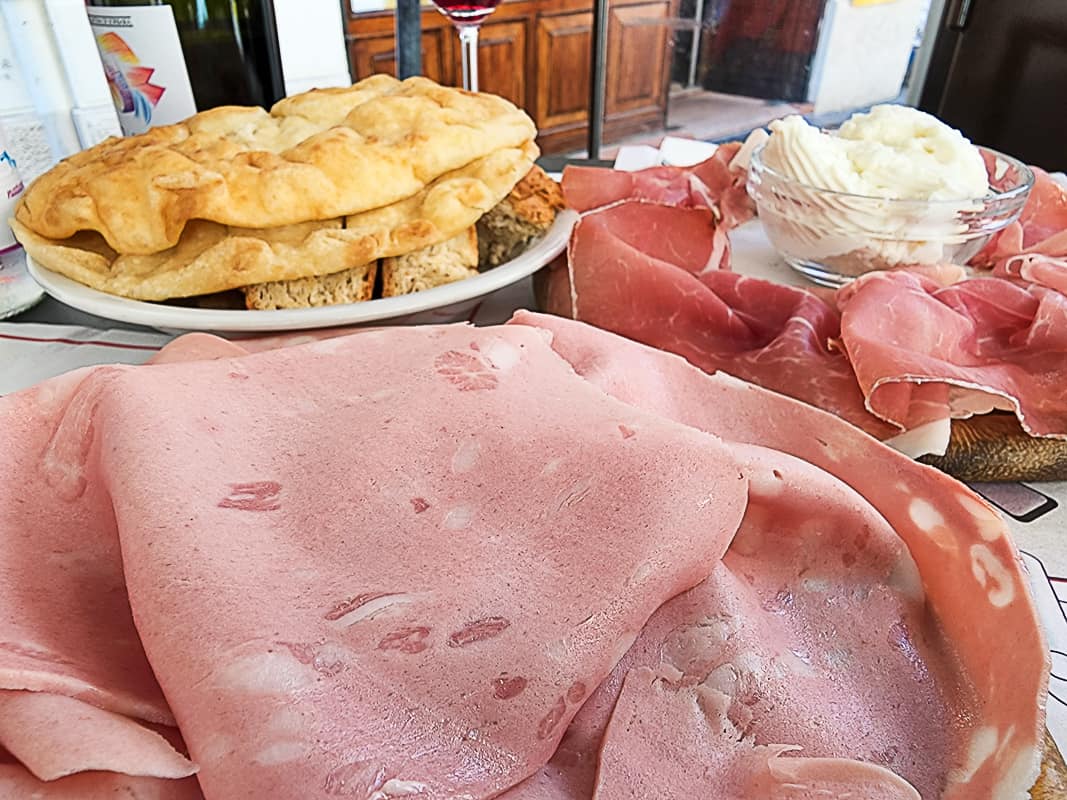
Mortadella Bologna IGP is a historic, finely cured Italian cooked pork sausage originating from Emilia-Romagna, characterized by its velvety texture, pale pink hue, and distinct white cubes of sweet neck fat (lardelli). Protected by European Union Indication of Geographic Protection (IGP/PGI) laws, authentic mortadella is crafted from finely ground pure pork, whole black peppercorns, and occasionally pistachios or myrtle berries—slowly dry-cooked in specialized hot-air ovens to achieve its signature delicate, aromatic flavor.
*This post contains compensated links. Find more info in my DISCLAIMER. As an Amazon Associate, I earn from qualifying purchases.
Quick Facts About Mortadella Bologna IGP
| Category & Attribute | Mortadella Bologna IGP Specification | Culinary Significance |
| Protected Classification | IGP (Indicazione Geografica Protetta) | Certified under strict EU laws regulated by the Consorzio Mortadella Bologna. |
| Geographic Origin | Bologna, Emilia-Romagna, Italy | Produced across Emilia-Romagna and traditional adjacent authorized regions in Northern/Central Italy. |
| Meat Composition | 100% High-Grade Pork | Premium lean pork muscle finely minced into an emulsion; strictly no meat by-products. |
| Fat Cubes (Lardelli) | Minimum 15% High-Quality Neck Fat | Sweet, firm neck fat (gola) diced into distinct white cubes that do not melt during cooking. |
| Aromatic Spices | Black Pepper, Myrtle Berries, Spices | Seasoned with whole/cracked black peppercorns, warm spices, and regionally Bronte pistachios. |
| Cooking Process | Slow Dry-Air Convection Ovens | Stoved for several hours to days at 70°C–75°C (158°F–167°F) to an internal core temp of 70°C, then cold-showered. |
| Traditional Slicing | Paper-Thin Slices (Velata) | Sliced whisper-thin on a deli slicer so the fat dissolves effortlessly on the palate. |
| Classic Culinary Pairings | Crescentina / Gnocco Fritto & Lambrusco | Served with warm fried dough, stuffed in rosetta bread, or whipped into spuma di mortadella. |
Table of Contents
The History & Origins of Mortadella
Ancient Roman Roots & The Mortarium
Mortadella is one of Italy’s oldest documented charcuterie products, dating back to the Roman Empire where pork meat was traditionally pounded into a fine paste in a stone mortar (mortarium) and seasoned with wild myrtle berries (myrtatum).
A funerary stele preserved in Bologna’s Archaeological Civic Museum depicting a Roman pig farmer and a stone mortar confirms that the craft of grinding and curing pork in this specific region dates back over two millennia.
Protected Geographic Status: What IGP Means for Mortadella
Since 1998, authentic Italian mortadella has been safeguarded by the European Union under the Mortadella Bologna IGP designation, guaranteeing adherence to strict production standards.
Mortadella is one of the many DOP and IGP products in Italy, meaning its production and ingredients are strictly regulated for quality. The IGP seal ensures that every sausage is made exclusively with certified high-grade pork cuts, seasoned according to precise consortia recipes, and dry-cooked without artificial coloring, excessive water, or synthetic binders.
What Is Mortadella – That’s Baloney
Like many kids who grew up in the States, I grew up on bologna sandwiches. I could spot that round plastic container, with the yellow backing, from a mile away. I still remember its sound when that plastic backing was ripped off.
The smell of the bologna, when it sizzled in a frying pan, is another thing I remember. Yes, my grandmother often made me fried bologna sandwiches, served on white Wonder Bread, with ketchup. An all-American bologna lunch was served.

As I got older, I started to despise baloney, and most of the other lunch meats my mother served me. Liverwurst. Olive loaf. That fake turkey meat. Processed ham. It got to the point where I despised it all.
I grew into an adult with a bit of processed meat PTSD from my overly baloney-saturated childhood.

As I started to eat Italian cured meats, it took me some time to develop a taste. To me, the prosciutto was raw, pancetta fatty, and mortadella was, well, baloney. It was round and pink, and to me “processed.” But, oh, was I mistaken about these famous Italian snack foods.
After 20+ years traveling to Italy and learning about the cuisine of Emilia Romagna – where mortadella is from – I figured it out. I learned all about the process while researching my book, The Food Traveler’s Guide To Emilia Romagna: How to taste the history and tradition of Italy. And, I realized Italian mortadella from Bologna is nothing like the baloney in the US. Instead, it’s one of the best foods in Italy.
Mortadella vs. American Baloney: The Key Differences
Growing Up with Baloney vs. Discovering Real Mortadella
Like many kids who grew up in the States, I grew up on bologna sandwiches. I could spot that round plastic container with the yellow backing from a mile away. The smell of the bologna when it sizzled in a frying pan is another thing I remember—my grandmother often made me fried bologna sandwiches served on white Wonder Bread with ketchup.
As I got older, I started to despise baloney and most processed lunch meats. When I began eating Italian cured meats, it took me some time to develop a taste. To me, prosciutto was raw, pancetta was fatty, and mortadella was, well, “baloney.” It was round, pink, and looked processed. But oh, was I mistaken.
After 20+ years traveling to Italy and researching my book, The Food Traveler’s Guide To Emilia Romagna, I realized Italian Mortadella Bologna IGP is nothing like mass-produced American baloney.
I am not sure how the mortadella meat that was eaten by Italian American immigrants turned into American bologna. There is the connection that mortadella was from Bologna, so I understand the name. But, I cannot understand what bologna became, considering its grandfather is a meat known for high quality for centuries.
There has always been the running joke that no one knows what kind of meat is really in baloney. This is the first thing that differs from its Italian grandfather. Mortadella is made 100% from pork meat.

Mortadella Is Not The “Odds And Ends”
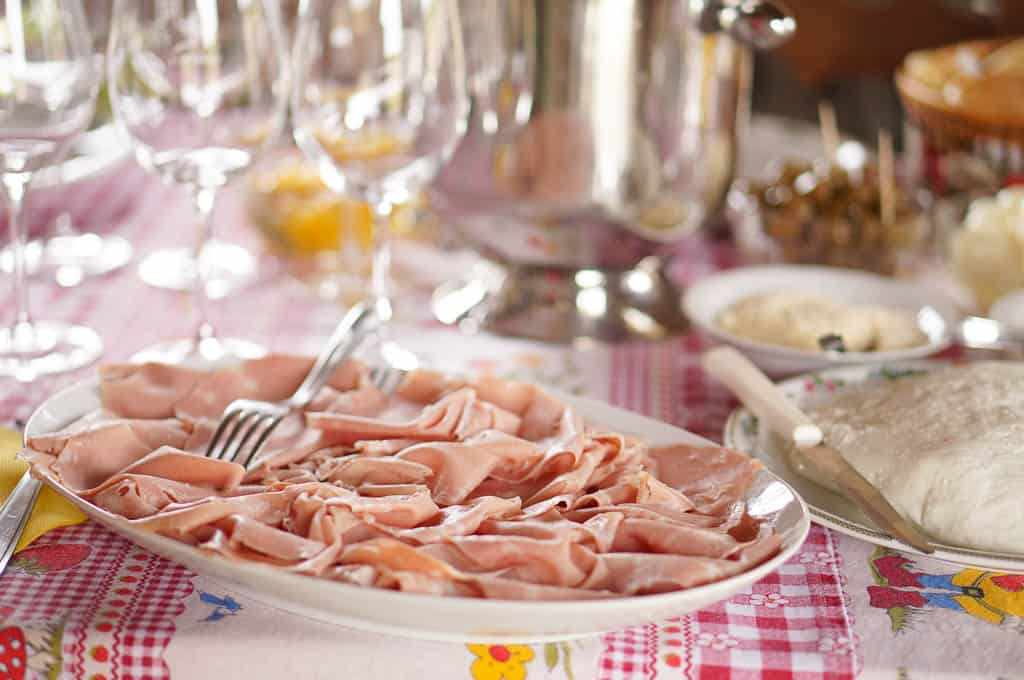
Mortadella and American baloney are fundamentally different products separated by meat quality, production methods, and strict legal standards.
Mortadella is one of the many DOP and IGP products in Italy, meaning its production and the mortadella ingredients are strictly regulated for quality. You certainly can’t say the same about baloney.
When researching the history of bologna in America, I came across this gem, which made me want to pull my hair out:
The bologna sausage is traditionally made from the “odds and ends” of chicken, turkey, beef, or pork. It is similar to the Italian mortadella, which originated in the Italian city of Bologna. The inexpensive deli meat is often pronounced and spelled “baloney.”
~Dictionary.com
Granted, this little nugget came from Dictionary.com and should not be quoted as a reference on the history of food (although I am). But, it highlights the discrepancy between Italian mortadella, aka bologna sausage, aka baloney.
| Feature | Authentic Mortadella Bologna IGP | American Commercial Bologna (Baloney) |
| Meat Source | 100% High-grade pure pork muscle | Mechanically separated scraps of chicken, turkey, beef, or pork |
| Fat Content | Whole, hand-diced sweet neck fat cubes (lardelli) | Emulsified, invisible liquid fats blended into a paste |
| Texture | Silky, delicate, melt-in-the-mouth when sliced thin | Rubbery, elastic, and uniform |
| Seasoning | Whole black peppercorns, myrtle, warm spices | Garlic powder, celery extract, liquid smoke, paprika |
| Cooking Method | Slow dry-air baking in artisan convection ovens | Steam-cooked or boiled in synthetic casings |
My Love Affair With Mortadella
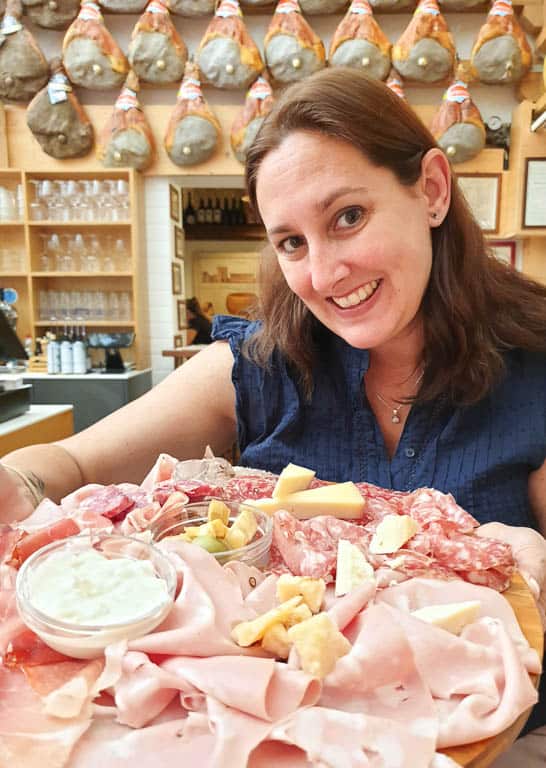
As we began to travel in Italy, and as we started to become budding connoisseurs of Italian food, I started to grow accustomed to the Italian cured meats. In fact, I now crave them. I’m the one to suggest ordering a giant plate of meat. I’m left licking my fingers at the end of the course.
When one of these meat platters is delivered to our table, and I see thinly sliced pieces of mortadella, I get almost giddy. I want to pick the slice up above my face, lift my chin, and allow the mortadella to descend into my open mouth. I imagine I look a little like a seal excited to be fed a big fish. But, I don’t care, because I love a good mortadella.
Just don’t call it baloney. I would much prefer a mortadella sandwich than a baloney sandwich, even for Italian breakfast!
Traveling To Italy? Check out our Italian Packing Guide.
How Authentic Mortadella Bologna Is Made

I knew that I liked eating mortadella. But I wanted to learn about what mortadella is made from. Our guide picked us up at our hotel in Central Bologna, and we hailed a cab for our morning tour of Pasquini, one of the top mortadella producers in Bologna.
It wasn’t very often that Mr. Pasquini opened his doors for tours of his decades-old production facility. Pasquini mortadella is very popular with the locals. Popular enough that there was a steady stream of customers coming in and out during our visit. But, not many people know that the Pasquini mortadella is still made within the Bologna city limits, just outside the city center.
In a small building tucked into a neighborhood, there’s no indication as to what goes on behind those doors, other than a small sign with Pasquini’s signature pig logo. It’s so hidden that our taxi driver was confused, thinking we were driving to a different Pasquini, an optometrist nearby.
I was also pleasantly surprised that Mr. Pasquini greeted us himself. I expected a tour from one of his employees, but to receive the inside scoop from a mortadella master was special. Mr. Pasquini was about to show us how the sausage is made.
Learn more about how to travel in Bologna and see our comprehensive Bologna Food Guide – What To Eat In Bologna.
How is Mortadella Made

It’s a fairly simple process that involves a few different steps of pressing and grinding pork meat, along with the characteristic white bits of fat. Those white bits are actually the meat from the throat of the pig.
Mr. Pasquini explained how to tell if it’s a high-quality mortadella: the white bits should remain connected to the pink meat after it is cut. If the white pieces start to separate, you are not eating Pasquini.
Essentially, all of this is mixed with a little seasoning, including salt and white pepper. I knew Mr. Pasquini would never share his secret mortadella recipe with us but it was to watch. It’s all filled into a giant mortadella casing and then, the real fun happens.
The casing is tied at one end, and then the entire mortadella, which weighs at least 12 or 14 kilograms, is carefully tied repeatedly. This helps the mortadella to retain its shape while it hangs, and while it’s cooked in a large, dry oven, for about 22 hours. There was a team of about five employees walking through each of these steps.
At one point, Mr. Pasquini stepped away from our tour to do some of the tying himself. He implied it was because they had to get the work done and if he didn’t help out it would never be finished. But, I think he wanted to show off his tying skills alongside the young guys he was training. After all, he’s the mortadella master.
How to Serve, Slice & Pair Mortadella in Bologna
Slicing Technique: Paper-Thin is Essential
Mortadella should always be sliced paper-thin (a velo, or “like a veil”) on a deli slicer so the delicate neck fat dissolves instantly on the palate.
When sliced thinly, the fat melts at body temperature, releasing its subtle sweetness and aroma without feeling greasy. For antipasto platters, it can also be served in small bite-sized cubes.
After seeing the process from beginning to end, of course, Mr. Pasquini offered us some samples of his thinly sliced mortadella. It was like a dream come true for me. And, in this case, I was happy to see how the sausage is made.
Unfortunately, since our visit Sr. Pasquini passed on, but he is known for leaving a mark on the world of mortadella. I feel privileged to have met him.

Traditional Emilia-Romagna Pairings
In Bologna, mortadella is served inside warm, hollow rosetta bread rolls, folded into freshly fried gnocco fritto (crescentina), or whipped with ricotta and Parmigiano Reggiano into Spuma di Mortadella.
Throughout Bologna, you’ll find dozens of restaurants and bars serving mortadella. One of our favorite places is Bella Vita just off Piazza Maggiore. They offer a great aperitivo which includes little sandwiches made with, you guessed it, mortadella.
Other pairing recommendations:
- Wine Pairing: Sparkling red Lambrusco di Sorbara or crisp Pignoletto Frizzante—the natural effervescence cuts cleanly through the rich pork fat.
- Cheese Pairing: Shards of aged Parmigiano Reggiano DOP or creamy Squacquerone di Romagna DOP.
- Bread Pairing: Enjoy mortadella in a fresh, warm gnocco fritto, a fried bread common in Bologna.
Where to Stay in Bologna for Food Lovers & Gastronomy
Staying in Bologna’s historic center puts you within steps of the medieval Quadrilatero market alleys, historic salumerie, and traditional osterie:
| Hotel Name | Location & Neighborhood | Category | Culinary & Location Highlights |
| Grand Hotel Majestic già Baglioni | Historic Center (Via dell’Indipendenza) | 5-Star Luxury Heritage | Home to fine-dining restaurant I Carracci, featuring elevated regional tasting menus. |
| Art Hotel Commercianti | Piazza Maggiore / Quadrilatero | 4-Star Boutique | Located right beside Basilica di San Petronio and seconds from historic mortadella delis. |
| I Portici Hotel Bologna | Northern Center (Via dell’Indipendenza) | 4-Star Design Hotel | Features an on-site Michelin-starred restaurant and private cooking masterclasses. |
| Hotel Corona d’Oro | Medieval Quadrilatero Quarter | 4-Star Classic | Situated along pedestrian lanes filled with traditional pasta shops and wine bars. |
FAQs – What is Mortadella?

What is mortadella made of?
Authentic Mortadella Bologna IGP is made of 100% finely minced lean pork muscle, diced sweet neck fat cubes (lardelli), whole black peppercorns, and warm spices (and occasionally pistachios).
Is mortadella raw or cooked?
Mortadella is a cooked cured meat. It is slowly baked in specialized dry-air convection ovens at 70°C–75°C (158°F–167°F) until the core temperature reaches 70°C, making it fully cooked and ready to eat without further preparation.
Does authentic Italian mortadella have pistachios?
In the city of Bologna, traditional mortadella is often made without pistachios, featuring only black peppercorns. However, mortadella with whole Sicilian pistachios is widely produced, recognized under IGP regulations, and popular across Rome and Central Italy.
What is the white stuff inside mortadella?
The white cubes inside mortadella are lardelli, which are small, hand-diced squares of premium pork neck and throat fat (grasso di gola). They are selected because they stay firm during baking and add a delicate, velvety sweetness to each slice.
What is the difference between Mortadella and Bologna?
Mortadella Bologna IGP is an artisanal Italian cured meat made from 100% pure pork muscle, whole spices, and diced neck fat. American bologna is a heavily processed mass-market imitation made from finely pureed meat trimmings (often chicken, turkey, or pork scraps) with emulsified fats and artificial flavorings.
What does mortadella taste like?
Mortadella has a mild pork flavor. It’s not as strong as bacon but more pork-flavored than a pork chop or pork loin. It also has a thicker mouthfeel than prosciutto.
Culinary Travel To Italy

Our Italy Travel Experience
Check out Food & Drink Destinations original founder Amber Hoffman’s book, the Food Traveler’s Guide To Emilia Romagna, which is available on Amazon. In addition to being a culinary travel guide to the region, it walks through how many of the typical Italian food products are made, like mortadella, prosciutto, and Parmigiano Reggiano.